Blockchain as It Was Meant to Be

STORAGE

Integrated distributed file storage for NFT's, Metaverse assets and other files

COMPUTE

EVM compatibility and multi-runtime support, allowing developers to use familiar tools and languages

DEMOCRACY

Rewarding computational effort fairly, by using collaborative rather than competitive consensus

Returning to blockchain's founding principles

The blockchain industry has drifted from its founding principles.

What began as a movement to democratize finance has evolved into systems that recreate the very exclusivity they sought to replace.

Some would say it's rich online virtual worlds, gaming, entertainment and some day the full Ready Player One experience.

Catalyst Network returns blockchain to its roots through concrete technical innovations that prove true decentralization isn't just an ideal—it's an achievable reality.

Catalyst Network

A protocol bridging Web2 and Web3

Mission

To build a blockchain that returns to the founding principles of this industry. Fairness, decentralisation and inclusion.

Vision

Our vision is a world where blockchain is accessible to everyone, regardless of wealth or geography. A world where anyone can contribute to the network and be rewarded for their efforts.

Testnet

We’re running a public test network with nodes in Asia, Europe, and the USA.

Blockchain's Centralization Crisis

💰

Ethereum Proof-of-Stake

Requires 32 ETH to run a validator. Systems that promised open participation can end up requiring significant wealth to participate

⛏️

Bitcoin Mining

Dominated by industrial farms with million-dollar ASIC investments. Individual miners can no longer compete.

🐋

DeFi Governance

Often controlled by token whales and venture capital. Token-weighted voting can concentrate decision-making power into a small number of hands.

The Mathematical Reality of Centralization

Concentration

Staking pools and custodians can accumulate a large share of validation power

Scale effects

Industrial mining can outcompete individuals through economies of scale

Wealth ≠ voice

Token-based governance often equates wealth with influence

Features

Collaborative Consensus

Unlike competitive mining or wealth-based staking, our collaborative consensus rewards work over wealth. No computational puzzles, no token requirements—just meaningful contribution to the network.

Multi-Runtime Architecture

Break free from single-language constraints. Deploy Ethereum contracts, Solana programs, or native code—all on the same network. Choose the best environment for your application.

Web2 Integration Bridge

Make blockchain accessible to millions of existing developers. Our service bus treats blockchain events like any message queue—no Web3 expertise required.

How Collaborative Consensus Works

1. Construction Phase

All producer nodes build candidate ledger updates from the transaction pool. No computational puzzles or token requirements.

2. Campaigning Phase

Nodes propose their candidate updates to peers. Majority agreement emerges through mathematical comparison.

3. Voting Phase

Nodes vote on the most popular candidate. Requires supermajority (>67%) for consensus, weighted by contribution history.

4. Synchronization Phase

Final ledger update distributed across network. All nodes update their local state and rewards are distributed.

Fair Launch Promise

Merit-based distribution that puts work over wealth

0 KAT

Tokens in circulation at launch

No Pre-allocation

Or insider advantages

Open Participation

Regardless of geography or wealth

Work-based Rewards

Through network contribution

Launch Phases

Phase 1: Genesis Launch (Month 1-3)

  • 0 KAT tokens in circulation
  • Open source node software released
  • Anyone can run a node and start earning
  • Rewards: 100% from network inflation

Phase 2: Transaction Economy (Month 3-12)

  • Users begin transacting, generating fees
  • Validators earn inflation rewards + transaction fees
  • Service providers enter the ecosystem
  • Economic activity drives token utility

Phase 3: Self-Sustaining Network (Year 1+)

  • Transaction fees cover most validator costs
  • Inflation rate adjusts based on network needs
  • Rich ecosystem of applications and services
  • Global, distributed validator set

How Catalyst Compares

Launch Type Initial Distribution Centralization Risk Regulatory Risk Accessibility
ICO/Token Sale Concentrated among buyers High (wealth-based) High (securities) Low (requires capital)
Pre-mine Team/investor allocation Very High Medium Very Low
PoW Launch Miners with hardware Medium (hardware costs) Low (no sale) Medium (hardware barrier)
PoS Launch Stakers with tokens High (wealth-based) Medium Low (token requirement)
Catalyst Fair Launch Merit-based earning Low (work-based) Low (no sale) High (open participation)


DISCOVER CATALYST ON YOUTUBE


Roadmap

Phase 1: Core Functionality & Testnet (Q1 2026)

Core Infrastructure

  • ✅ Collaborative consensus in Rust
  • ✅ EVM runtime integration
  • ✅ Network topology
  • ✅ Cryptographic primitives in place

Deliverables

  • ✅ Public testnet running across Asia, Europe, and the USA
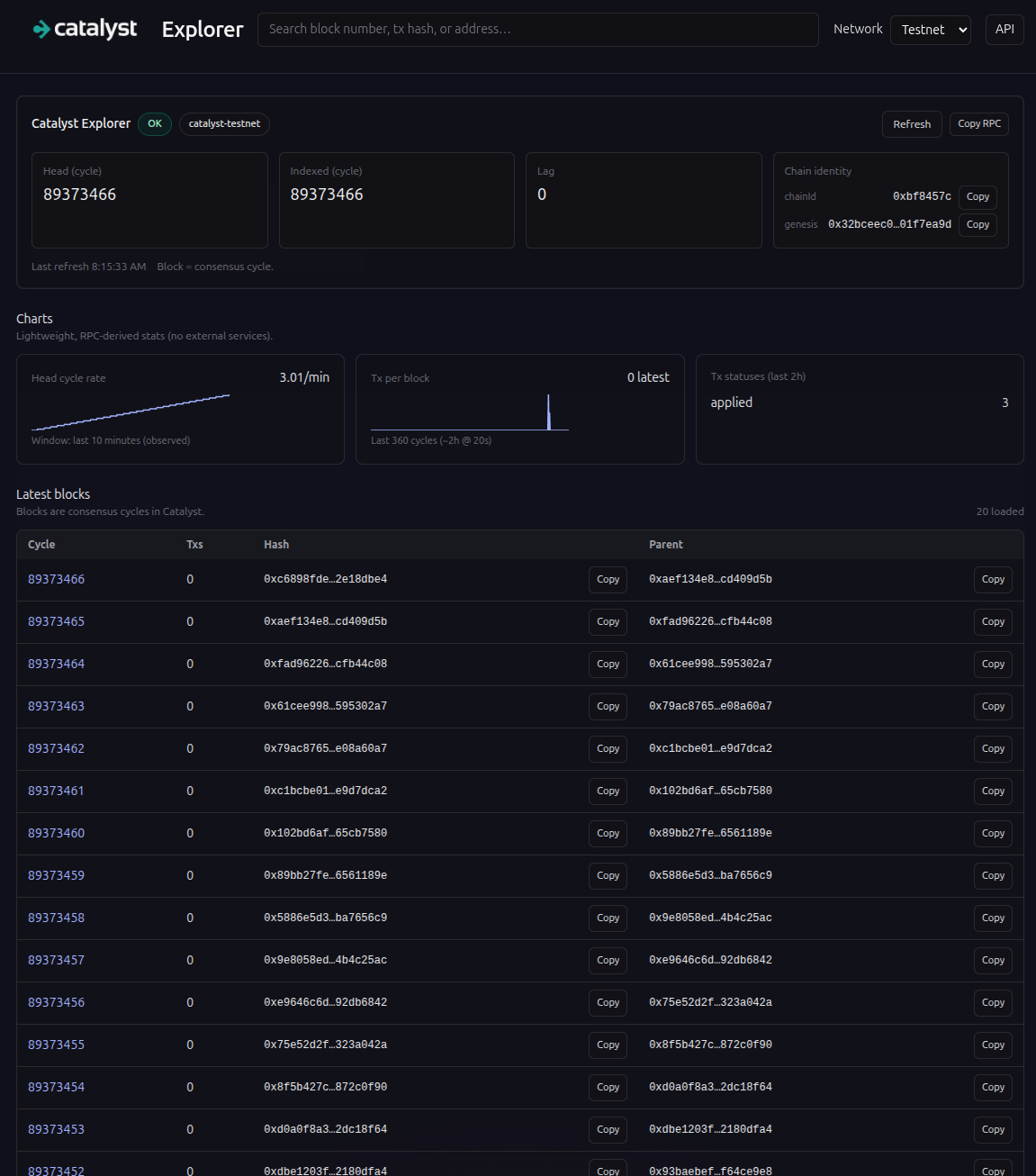
  • ✅ Block explorer
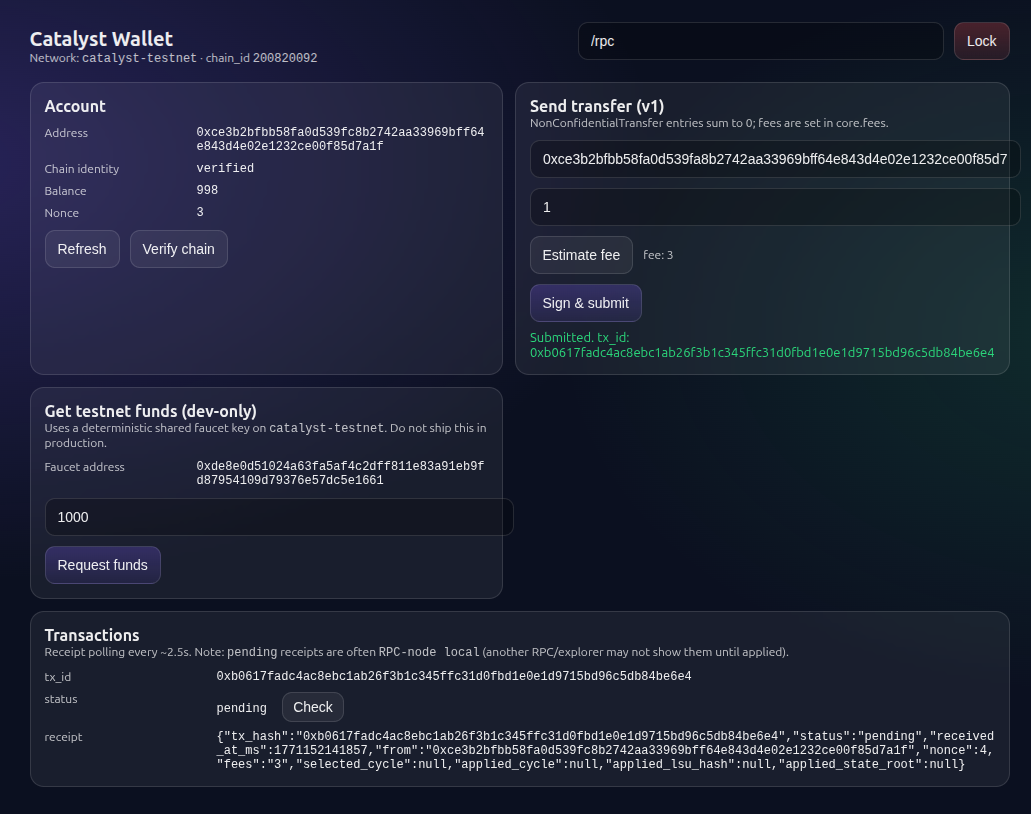
  • ⏳ Wallet (available but in development)
  • ⏳ Developer tooling

Phase 2: Stability & Tooling (Q2 2026)

Stability hardening

  • ⬜ Tech stack review, hardening and optimization
  • ⏳ Improvements to wallet, explorer and tooling
  • ⏳ Documentation, guides, and onboarding
  • ⬜ Genesis block creation

Deliverables

  • ⬜ Main network
  • ⬜ Wallets in iOS, Android and Chrome stores
  • ⬜ Jeskei, DeFi, and other projects deploying
  • ⬜ Additional tools including AI skills

Phase 3: Ecosystem (2026+)

Ecosystem Growth

  • ⬜ Additional runtime environments
  • ⬜ Cross-chain bridges to major networks
  • ⬜ Advanced privacy features (ZK circuits)
  • ⬜ Enterprise integration tools

Success Metrics

  • ⬜ 1000+ active validator nodes globally distributed
  • ⬜ 100+ applications deployed across multiple runtimes
  • ⬜ Growing transaction volumes
  • ⬜ 10,000+ real active daily users
Follow progress on the development plan


Card image cap


Catalyst Network Gets Green Light at Blockchain Live


New announcements and a workshop on building a Web3.0 Twitter service.


READ MORE


Card image cap


U.K. Blockchain Firm Heads for Switzerland


Blockchain firm which just raised $4 million is heading to Switzerland.


READ MORE


Card image cap


Crypto foundations continue to thrive in Switzerland


Yet more overseas blockchain firms are coming to Switzerland.


READ MORE